Sunday, March 21, 2010
MODULE 9 FLOW MAPS

Sunday, March 14, 2010
MODULE 8 DOT MAPS
Monday, March 1, 2010
MODULE 7 PROPORTIONAL SYMBOL MAPS

Wednesday, February 24, 2010
MODULE 6 CHOROPLETH MAPS

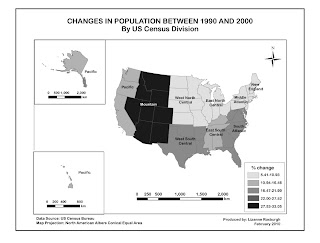
I am still struggling with layers, but things are improving. I learnt how to proportionally constrain the size of a layer (other than by manual eyeballing), which is a useful skill. I had a few problems importing from ArcGIS, especially with regard to font and size. I think perhaps ArcGIS saves in an older version of AI. I had to redo some of the text in AI. Still a bit frustrating to work with AI, but I am beginning to see potential here.

I wanted to make the divisions visually clearer and non-ambiguous but I could not figure out how to overlay pattern upon colour or how to outline a division with a darker colour. But I don't think it is that important to know exactly which state is in which division so the slight ambiguity should not be a problem. Nevertheless it would be good to find this out in future.
Sunday, February 14, 2010
MODULE 5 MAP COMPOSITION
Monday, February 8, 2010
MODULE 4 TYPOGRAPHY
I enjoyed using the Bauhaus font to label the National Park and City features, and I looked it up in Wikipedia. This font was based on Herbert Bayer's 1925 experimental Universal typeface. Who was Herbert Bayer? He was an Austrian graphic designer and artist and the last surviving member of Bauhaus. He died in 1985. He studied under Wassily Kandisky, and eventually ended up living in Aspen, Colorado. The Denver Art Museum apparently contains a large number of his works.
Tuesday, February 2, 2010
MODULE 3 DATA CLASSIFICATION

Which classification best represents the data and why?
The data are positively skewed. Thus using the Equal Interval classification is not ideal, as most counties fall into the first two classes, with the last class having very few counties.
The distribution of data across Natural Break classes is also clumped, again with the first two classes containing most of the data. This would be the method of classification that I would probably avoid in general as it is not easily interpretable and is difficult to compare between maps.
Both Standard Deviation and Quantile classifications produce a more even distribution of data as there are approximately equal number of counties in each class. However, as the data are positively skewed, and thus not normally distributed, the Standard Deviation method would be best used if the data were normalized first.
I would thus choose the Quantile method as the best method of representation for this data set.